Wednesday, December 15, 2010

Happy Birthday to Us! (Gratefully celebrating 4 years of Boxing the Octopus)

This blog was born out of many hours of writerly conversation, countless cups of coffee, a shared love of reading, and mutual dedication to writing. In one of those conversations, I referred to the writing life as "boxing the octopus", and Colleen instantly clapped on: "That's the name of our blog." A few days later -- four years ago today -- she posted the first entry, Welcome to Boxing the Octopus: Your Guide to the World of Commercial Fiction:
We're glad you stopped by and hope you'll pop by often as Boxing the Octopus takes on your questions about the world of spinning lies -- we mean fiction -- for fun and profit. In the coming weeks, we'll be introducing ourselves, organizing helpful material, and giving you our take on staying sane and solvent as a novelist.
We two Founding Mothers eventually came up with this mission statement:
To encourage and inform emerging writers, support books and authors we love, dialogue with peers in the publishing biz, and reflect on a life and living made of books.
I think BoxOcto has made good progress toward these goals in the last four years -- and I might add, we've both managed to stay sane and solvent as the book biz went totally off the rails. We've added some terrific blog crewmates over the last year or so, and God bless them, but I want to take this opportunity to thank Colleen Thompson, my dear kindred spirit and respected colleague, for sharing this journey with me from the beginning. The day we met, Colleeny was doing a table signing at Border's. I was officing in the upstairs coffee shop because my plumbing was being repaired. It was one of the luckiest days of my life, professionally and personally.

Tomorrow and Friday, watch this space for BoxOcto's greatest hits. (And more holiday book recomendations!)


Tuesday, December 14, 2010

Wonderful Poet Dean Young Needs a Heart Transplant

. . . and needs your help.  Please follow this link to learn more.

Dear Friend by Dean Young


What will be served for our reception
in the devastation? Finger food, of course
and white wine, something printed on the napkins.

We were not children together
but we are now. Every bird knows
only two notes constantly rearranged.

That’s called forever so we wear pajamas
to the practice funeral, buckeroos
to the end. We make paper hats
of headlines and float them away.

My home made of smoke,
tiny spider made of punctuation,
my favorite poem is cinder
scratched into a sidewalk.

My friend’s becoming the simplest man,
he sees a lesson in everything,
in missing his train,
in his son hollering from the first branch,
Dad, guess where I am.

I was with him for my first magpies,
governmental and acting like hell.
And the new nickel
with Washington hard to recognize.

We’d driven by a Rabbit flattened
by an upset truck, jars of Miracle Whip
broken over the toll road in heavy snow.

We watched an old lady
eat a hot dog in a bun
with a knife and fork.

A few emeralds winged off
a fruit leaf.

What happens when your head splits open
and the bird flies out, its two notes deranged?
You got better, I got better,
wildflowers rimmed the crater,
glitter glitter glitter.

We knew someone whose father died
then we knew ourselves.
Astronomer, gladiator,
thief, a tombstone salesman.

All our vacations went to the sea
that breathed two times a day
without a machine.
We got in trouble with a raft
doing what we promised not to.

Further out to be brought further back.

There’s my friend in his squashed hat
trying to determine if a dot
is a living thing and do no harm.

He’s having trouble remembering street names
but there’s still plenty of Thoreau.

All that a human is made of is gold,
very very little gold.

#BuyThisBook: Lauren Willig schools us on must-reads for historical romance lovers on your list

The Mischief of the Mistletoe: A Pink Carnation ChristmasEarlier this month, we chatted up Lauren Willig about her latest release, The Mischief of the Mistletoe: A Pink Carnation Christmas, and the historical romance course she's teaching at Yale. If you're shaking the tree for gift ideas for the romance reader you love, here's a recap and buy links for a few of the books in Willig's syllabus:

Northanger Abbey"We opened the class with Austen’s Northanger Abbey, which tackles the seminal question of the relationship between novel and reader," Willig said. It's one of Austen's earliest works, but it wasn't published until after her death. Crumbling castles, cryptic messages, paternal tyranny, and a wry send-up of literary fops of the day.

The Flame and the FlowerAfter due respect to the mother of the Regency romance, Georgette Heyer, the class moved on to Kathleen E Woodiwiss’ The Flame and the Flower. The moment Willig mentioned it, I found myself up in the mulberry tree in our front yard in Wisconsin, circa 1974. I clearly remember seeing this book on a turning wire rack near the front door of the Onalaska Public Library. I consumed it like I was on a desert island with a chocolate cake and returned the next day for The Wolf and the Dove. It was my transition summer to "grown up books" and formed a concept of what romance novels are in my mind.

Lord of Scoundrels"Using Woodiwiss as our bridge to the American romance tradition, we examined 'old school' writers McNaught and Lindsey before moving on to Kleypas, Quinn, James, and the more outré takes on the genre, including Regency gothic, Regency vampires, and Chick Lit," said Willig. "We had papers ranging from the Christological imagery in Chase’s Lord of Scoundrels to boxing as metaphor in Heyer’s Regency Buck. Their ingenuity and insights forever changed the way I look at several well-known texts."

Read the rest of our interview with Lauren Willig.

Monday, December 13, 2010

The Afghan Women's Writing Project

“I was never ready to share my personal life, but now life has brought me in a crossroad with no option and no hope,” writes the anonymous author of a posting to the Afghan Women’s Writing Project. “I don’t want anyone to know this is me. If anybody knows, it means that will be my last day of life. My family and uncles will kill me. It is not just a word that comes out of my mouth. They would surely kill me.”

The idea that simply writing about your day and then sharing those thoughts might literally cost your life is, for us, unthinkable. But for many of the women in Afghanistan, it is a brutal truth. But thanks to the efforts of the extraordinary Afghan Women’s Writing Project, the essays, poems and stories written by these courageous women are now being read by people around the world.

An online magazine dedicated to empowering and nurturing the voices of Afghan women, the AWWP pairs volunteer women novelists, teachers, poets, journalists and screenwriters here in the United States with young women in Afghanistan. Writing workshops are taught in three secure online classrooms and the women’s work is then posted on the AWWP web site -- allowing them to have a direct voice in the world, not one filtered through male relatives. The AWWP was founded by journalist and novelist Masha Hamilton, herself no stranger to life in dangerous places. Hamilton worked as a correspondent for the Associated Press in the Middle East, where she covered the intefadeh, the peace process and the partial Israeli withdrawal from Lebanon. She then spent five years in Moscow and covered the collapse of Communism as a correspondent for the Los Angeles Times and NBC/Mutual Radio. Now living with her family in New York City, Hamilton’s novels have won wide critical acclaim. Her most recent, 31 Hours, was selected by the Washington Post as one of the Best Books of 2009.

Masha, how did you move from a journalist reporting from Afghanistan to the creation of the AWWP
?
When I first visited Afghanistan in 2004, I was able to talk to women in prison in Kabul and Kandahar, child brides, the matriarchs of families that grow opium. Returning in November of 2008, I found a changed country. Due to kidnapping concerns, I was not able to travel as I had before. A lot of the optimism was gone from Kabul and as the women discussed the Afghan government’s plan to open negotiations with the Taliban, there were sharp fears. Few ruled out the possibility of a return to conservative Islam and I began to fear we could lose access to the voices of Afghan women if we didn’t act soon. I’d been wanting for some time to teach an online writing class to women in Afghanistan and it seemed imperative to set it up immediately. I began by teaching an online workshop myself, but quickly understood the demand would outstrip my ability to meet it and reached out to set up the AWWP. Today, we have more than seventy gifted volunteer mentors who teach on rotating basis.

In so many instances, it requires an act of extraordinary courage for a woman to simply send her work to the AWWP. I’ll always remember the story you shared with me of a woman who walked four hours through Taliban controlled territory to post a single poem. How do you protect the safety of your writers?
Most of the writers participate in the project partially or entirely in secret from friends and family, so we use their first names only and cut out identifying details, such as names of other family members or specific locators. On very rare occasions, we also publish a piece anonymously because we feel the security concerns are so high -- that the woman's life might actually be in danger if a relative or neighbor were to discover what she had written. This October, the AWWP opened the Women's Writing Hut. It’s located in a small apartment building in one of Kabul’s safer neighborhoods, unmarked from the outside, and a building guard lives on the premises. It has laptops and books as well as Internet service and offers the women who come an opportunity to not only post their work but to spend time with other writers. We hope it will be the prototype for what will eventually be Afghanistan’s first women-only Internet café.

Are there any limitations on what contributors may write?
We encourage the women to write about their deepest concerns, but also their history, what makes them laugh, what they believe in or feel passionately about. These are average women and they have a variety of viewpoints. They share sad hard stories about life in a Taliban held province, but also stories that are funny and poignant. We believe that once a woman begins to write about her life, she begins to gather the intention and will to change her life where needed. I also firmly believe that change to Afghanistan is going to come from within, not from outside pressures, and that women are going to be crucial to that change.

Reports say romance is the hottest e-book market (but the big news is that some people are surprised)

According to this article in the New York Times...
If the e-reader is the digital equivalent of the brown-paper wrapper, the romance reader is a little like the Asian carp: insatiable and unstoppable. Together, it turns out, they are a perfect couple. Romance is now the fastest-growing segment of the e-reading market, ahead of general fiction, mystery and science fiction, according to data from Bowker, a research organization for the publishing industry.
And this article in World News Media Headlines corroborates with data from Bowker...
Romance is currently the fastest growing segment in the market of e-reading, ahead of other categories such as mystery, general fiction, and science fiction. ...All Romance, an online retailer of e-books, reported that sales have increased twofold, with the raciest books being the most sought after.
Interesting.

#BuyThisBook: "Safe from the Sea" by Peter Geye

Wracking your pine cone and egg nog addled brain for gift ideas? We asked our publishing peers and peeps to help us recommend a book every day from Black Friday to Christmas Eve!

Safe from the Sea by Peter Geye
Recommended by Caitlin Hamilton Summie, book publicist and marketer
Perfect for Dads, sons, daughters, sailors, Midwesterners, boat and sailing fiends, avid readers

"Set against the dramatic landscape of the Minnesota north shore, this is the story of an estranged father and son reconnecting thirty-five years after the father survived the tragic wreck of a Great Lakes ore boat."

“Give this book to readers of David Guterson and Robert Olmstead...” ~ Booklist

“Inspiring, wise, and enthusiastically recommended for all readers.” ~ Library Journal

Buy from Amazon
Buy from Barnes & Noble
Buy from IndieBound

Sunday, December 12, 2010

#BuyThisBook: "First of State" by Robert Greer

Wracking your tinsel and sugar plum addled brain for gift ideas? We asked our publishing peers and peeps to help us recommend a book every day from Black Friday to Christmas Eve!

First of State by Robert Greer
Recommended by Caitlin Hamilton Summie, book publicist and marketer
Perfect for mystery buffs, fans of African-American fiction, and people who love to read about the West.

"A prequel to the popular CJ Floyd mystery series. Equally a white-knuckle-ride murder mystery and a tale of a traumatized young Vietnam veteran coming to terms with his past, First of State features the kind of fresh characters, street-smart dialogue, and ingenious plot twists that have made this series a critical and commercial success."

Buy from Amazon
Buy from Barnes & Noble
Buy from IndieBound

Bad Writing: the movie (Vernon Lott's documentary bravely asks authors why his own writing sucks)

Can't wait to see this! Lott sets out on a quest to find out exactly why his bad poetry is so bad, and gets logical, hilarious, insightful answers from George Saunders, Margaret Atwood, Miles Corwin, Nick Flynn, Aimee Bender, D.A. Powell, Lee Gutkind, Steve Almond and David Sedaris.

Saturday, December 11, 2010

So you've discovered that you're a fictional character . . .

In one of my facebook breaks between writing and grading papers, I found this article from the fabulous people at cracked.com. Too funny, way too funny. Check it out:

Realizing you're a character in a work of fiction can be startling. At the moment, you probably feel like you're trapped in an elevator that's in freefall, and your mind has somehow hit the ground before the rest of your body.

What you're going through is completely natural for someone in your uniquely regrettable situation. Believe it or not there's a lighter side to be found in all the existential blackness you're feeling at the moment.

Read the rest here. And while you're at it, you tell me: what fictional universe do you think you're trapped in?? Who is your author?


Buy This Book: "The Witch of Portobello" by Paulo Coelho (Perfect for nieces and other magical beings)

Spent some quality time with my fabulous niece Jenny last week, and Paulo Coelho's wonderful book The Witch of Portobellocame up in conversation. It's been a while since I read it, but it's one of those books that swept through book clubs a few years ago. I immediately hopped online and ordered a copy for Jenny to read on the flight home, and I highly recommend it for the Christmas stocking of the open-minded, free-spirited reader in your life.

From Margaret Flanagan's Booklist review:
Best-selling fabulist Coelho continues to transform his trademark combination of mysticism and storytelling into spellbinding examinations of the human soul. In this deceptively simple novel, a bereaved lover attempts to chronicle, dissect, and comprehend the often-twisted path followed by Athena, otherwise known as the Witch of Portobello Road. An orphaned Romanian gypsy, adopted as an infant by adoring Lebanese parents, Athena recognized and struggled with the power of her magical gifts at an early age. Spurred on by truths and passions inaccessible to most of her contemporaries, she traipsed around Europe and the Middle East in search of acceptance, enlightenment, and a truer path...
Be intrigued. Be very intrigued...

Greatest. Critique group. Ever. (Watch the F'ing Fathers hammer out the rough spots on WIP)

Via the delicious Jen Singer of MommaSaid. And particularly timely, since Colleen and I were just yesterday discussing the importance of a strong critique group...

Friday, December 10, 2010

Buy This Book: Aron Ralston's "Between a Rock and a Hard Place" (the gut-wrenching memoir behind "127 Hours")

Colleen and I both read and loved Ralston's memoir when it came out, and this week I was blown away by the movie "127 Hours".

In 2003, Ralston was canyoneering in Utah and was trapped in a deep crevice when a tumbling rock smashed his hand against the canyon wall. Six days later, he made headlines around the world when he stumbled out of the canyon, having amputated his arm just below the elbow. The fact of that is gruesomely fascinating enough to motorize a blitz of publicity, but what makes this book so emotionally beefy and enduring (and the movie very successfully captures this) is the unobscured view of what human is. The breathtaking ease of a monumental mistake. The sharp knife of regret and the dull blade of self-reliance. Our need for each other and our need to deny it. What matters. What we fear. What we're willing to do to survive.

"127 Hours" is one of the best movies I saw this year. James Franco (whose book Palo Alto: Stories was released by Scribner this fall) did a serious deepdive for this performance, and please, please do see this movie on the big screen. Or book a flight to Utah.
Thursday, December 09, 2010

Who's on your list? (Author Claudia Sternbach is in a giving mood)

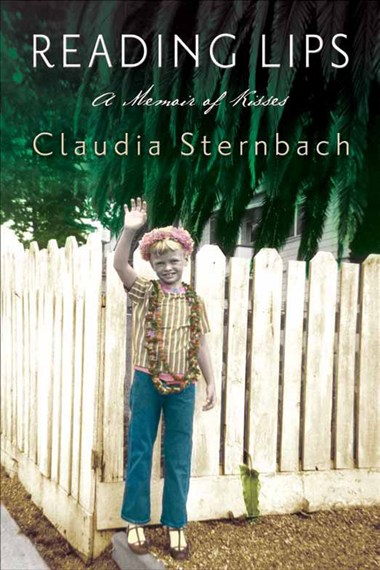
Claudia Sternbach's forthcoming Reading Lips: a Memoir of Kisses rings true and sweet as a music box. In a sea of memoirs based on big marketing hooks, Sternbach’s subtle theme is refreshing and, you come to realize, profound. Flawless pitch and balance. Guileless, unaffected writing. A book club’s dream date. I loved this perfect little opal earring of a book. After devouring an advance copy, I promptly pre-ordered copies for friends. (It's coming out in April, just in time for Easter baskets.) I also asked Claudia to stop by and tell us about books she might be giving for the holidays. Here's what she has to say:

So, the other evening while watching the gigantic film extravaganza, Avatar I wondered if I might add James Cameron to my holiday gift giving list.

Not that we have ever met. Not that he needs anything from me that he can't with his millions, purchase for himself, but as I sat trying to become mesmerized by all of the big, blue, excitement on the screen I kept thinking about a book I happen to love which while reading made my heart pound faster than anything this film was doing. Not that there is anything wrong with the movie or any other of his super-size films. It is just that I believe James is in danger of falling into the bigger is better trap to the point where the heart of the story may get lost in all the flash and bang.

If Jimmy, as I would call him if we were gift exchange buddies, would spend a few evenings sitting quietly with Per Petterson's novel Out Stealing Horses, he might find himself recalling a time before special effects were available and the story itself packed an emotional punch, rather than a giant 3-D Transformer. Pettersen places the reader in a small cabin in the Norwegian woods in the middle of winter and quietly builds a tale that unfolds with the subtlety of the approaching Nordic spring. The emotional impact is as large as the iceberg which took down the Titanic. But without the orchestra playing on the deck or Leonardo DiCaprio turning into an ice pop.

And as long as I am in the book giving mood I believe I might pick up a dozen copies of Geraldine Brooks' People of the Book to wrap with bright paper and shiny ribbons and share them with my friends who have made the switch to e-readers. Not that there is anything wrong with those clever electronic devices. They are quite handy and an amazing invention, if you ask me. But. I just don't want my gadget-loving friends to forget about actual books. The beauty of holding in your hands something more than plastic. A book, perhaps paperback, or leather bound. The pages crisp or softened with age. An item handed down by a family member or checked out of the library or purchased new and if one is really lucky, inscribed by the author.

People of the Book is a novel about a work of art. A hand printed, illumination passed down through generations, hidden during times of war, smuggled from one country to another. Not, I will admit, the typical history of any book we have sitting around the house. But Brooks reminds us that a book is not simply the story. It is the object itself. A treasure.

Then there is my husband, Michael. We exchange very little when it comes to the holidays but a book which may find its way into his stocking may be Here is New York, by E.B. White. A perfect little jewel so slim and elegant one should read it while eating fine chocolate truffles and sipping golden, bubbly Champagne from a crystal flute.

Written in the summer of 1948 it is a love letter to the city. It is tender and witty and explains better than I ever could what makes some people fall in love with that place on the planet. What keeps me going back again and again to wander the canyons and sit by the river. Michael has never felt his heart leap at the sight of the skyline or experienced complete contentment while standing on a subway platform. Perhaps this book could change all that. Or at the very least, help him understand my deep and abiding affection for this place I have made my second home.

Read an excerpt from Claudia Sternbach's Reading Lips: A Memoir of Kisses and watch this space for more on her publishing journey with this remarkable book.