Wednesday, March 09, 2011

Buy This Book: Jasper Fforde's next Next book "One of Our Thursdays Is Missing"


I got hooked on Jasper Fforde's Thursday Next books several years ago on a trip to Montana. My literary agent had recommended I read the first book in the series, The Eyre Affair, as a crash course in world-building. I listened to it while I was driving from Seattle to Billings for a series of speaking and book events, and at every book store I visited, I talked up Fforde's ingenious premise, which is pretty much like crack for book nerds.

Thursday Next works for Jurisfiction, a British government agency in charge of literary crimes and capers. (In The Eyre Affair, Next pursues the villain through the Bronte landscape after the abduction of Jane Eyre.) Art imitates life in the recent installment, as all hell is breaking loose in BookWorld. No one will find this book more hilarious or more painful than writers. (And yes, my agent was spot on with her advice. The world-building is phenomenal. This is definitely one of those writers you read to become a better writer.)

Per the PR:
All-out Genre war is rumbling, and the BookWorld desperately needs a heroine like Thursday Next. But with the real Thursday apparently retired to the Realworld, the Council of Genres turns to the written Thursday.

The Council wants her to pretend to be the real Thursday and travel as a peacekeeping emissary to the warring factions. A trip up the mighty Metaphoric River beckons-a trip that will reveal a fiendish plot that threatens the very fabric of the BookWorld itself.
Tomorrow Jasper Fforde stops by to talk about the longevity of this wonderfully brainy and unique series, the art of world-building, and what's next for Next.

Tuesday, March 08, 2011

Avon Jumps Into the Digital Age

From Publisher's Lunch comes word of another "legacy publisher's" new e-book-only romance imprint:

Yesterday Avon announced its digital-first imprint, Avon Impulse, which will feature ebook novels and novellas (with POD editions also available) by current Avon authors and aims to "seek new talent to nurture in an e-book marketplace that finds romance experiencing expansive growth." The first title will be Katherine Ashe's enovella, "A Lady's Wish," released next week, with plans to publish at least one new title every week going forward. Authors will not receive an advance, but will get 25 percent net royalties for the first 10,000 copies sold, and 50 percent thereafter. Unlike Harlequin's digital imprint Carina Press, Avon Impulse will use DRM, just like all of the traditional Harper imprints.

Authors can submit using an easy online form. Check it out by clicking through to the Avon Impulse website.

So what does an author gain by going with Avon Impulse or Carina Press rather than self-publishing to, say, Kindle, which offers a 70% royalty? Editing, for starters, along with net galleys, cover art and marketing support, plus whatever the prestige factor's worth to you. For many writers, I think this is a perfectly viable choice, especially since the current publishing environment (particularly in mass market original) is making it so tough to break into print.

Does anyone else want to weigh in on the pros and cons of the route?

Monday, March 07, 2011

Cool Idea of the Day from Shelf Awareness

Cool Idea of the Day: Algonquin Book Club

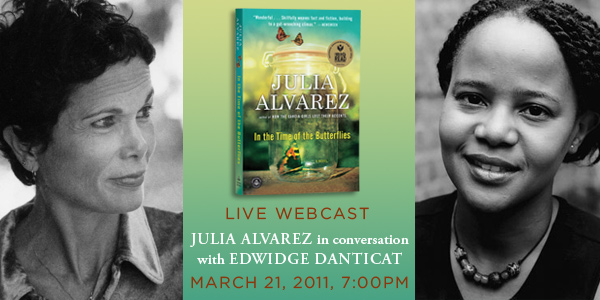
Algonquin Books has launched the Algonquin Book Club, which will hold four literary events a year at which an Algonquin author will be interviewed by a notable author. The events will be webcast live, and webcast viewers will be able to chat with other viewers. At the first book club event, which takes place on March 21 at Books & Books, Coral Gables, Fla., Edwidge Danticat, author of Brother, I'm Dying, will interview Julia Alvarez, author of In the Time of Butterflies.

For this first reading, the Algonquin Book Club site offers an original essay by Alvarez about the novel, a description of the book, bios of the author and interviewer, a reading group guide, book club tips and some culinary treats--wine and recipe pairings related to the book, some recipes from Alvarez and recipe favorites of characters in the book.

In addition, Algonquin is giving away signed copies of In the Time of Butterflies and Algonquin Book Club tote books--readers may enter the contest for these by leaving a comment on book club blog posts, by tweeting about it using #AlgBookClub or by posting on the discussion section of Algonquin's Facebook page. Anyone with questions for Alvarez can post them on any of those places and they may be asked during the event.

The other three events for this year have been scheduled. On April 26, Kathryn Stockett, author of The Help, interviews Sara Gruen, author of Water for Elephants. (The movie based on the book opens on April 22.) On August 18, Terry McMillan, author of Getting to Happy, gets to interview Heidi Durrow, author of The Girl Who Fell From the Sky. And on October 20, Patricia Cornwell, author of Port Mortuary, interviews Robert Goolrick, author of A Reliable Wife.

Kurt Vonnegut's Eight Rules for Writing a Short Story

Thought this would go nicely with Kathryn's post on the current short fiction competition over at The Texas Observer: 

1. Use the time of a total stranger in such a way that he or she will not feel the time was wasted.
2. Give the reader at least one character he or she can root for.
3. Every character should want something, even if it is only a glass of water.
4. Every sentence must do one of two things—reveal character or advance the action.
5. Start as close to the end as possible.
6. Be a Sadist. No matter how sweet and innocent your leading characters, make awful things happen to them—in order that the reader may see what they are made of.
7. Write to please just one person. If you open a window and make love to the world, so to speak, your story will get pneumonia.
8. Give your readers as much information as possible as soon as possible. To hell with suspense. Readers should have such complete understanding of what is going on, where and why, that they could finish the story themselves, should cockroaches eat the last few pages.

From his book Bagombo Snuff Box: Uncollected Short Fiction.

Tools for Plotting: Chris Vogler on The Hero's Journey


For the past few weeks, I've been bashing my head against the wall, struggling to shape an amorphous blob of a "big idea" into what I hope will become a satisfying story, an epic journey for both the story's heroine and its readers. Recently, I came across a mention of Chris Vogler's wonderful The Writers Journey: Mythic Structure for Writers, which is based on the work of Joseph Campbell,
and I was flooded with relief. Although there are plenty of other ways to tell a story, I've always loved reading, watching, and writing the classic hero's journey-styled tale. For the writer, the conscious examination of the unconscious structure we're all programmed to recognize can help to shore up structure in a way nothing else can.

This week, I'm going to try sketching out my heroine's journey by pulling this favorite from my personal toolbox. If you, too, could use a reminder (or an intro) check out this quick video with of screenwriting story consultant Chris Vogler speaking on the stages. The accompanying screen shots from The Matrix are extremely helpful, too.

And if you don't have the book, consider clicking through the link and picking up a copy. This is one of a handful of go-to resources I've used again and again throughout the years.

Saturday, March 05, 2011

Calling all Writers of Short Fiction . . .


This contest, sponsored by The Texas Observer, could be a great opportunity. Limit is 2500 words, guest judge is none other than Larry McMurtry. Deadline: May 1. Entry Fee: $25. (For an extra $10, you can get your story critiqued by fiction editor David Duhr)

Good luck! (And why does the mere mention of McMurtry's name make me want to go back and reread Lonesome Dove?)

Brilliantly hilarious "Let's Panic About Babies" book trailer (Did I mention it's brilliant?)


I am buying Let's Panic About Babies!: How to Endure and Possibly Triumph Over the Adorable Tyrant who Will Ruin Your Body, Destroy Your Life, Liquefy Your Brain, and Finally Turn You into a Worthwhile Human Being by Alice Bradley and Eden M. Kennedy as a reward for this brilliant trailer, if nothing else.

Per the PR:
Babies. Some of us want one. Some of us already have one. And some of us even were one.

But what are “babies,” exactly? Are they really tiny people? How did they get inside larger people? How will they get out? And if you’ve got one, what do you do with it? Our most cutting-edge scientific researchers have, to date, only mumbled theories and then distracted us all with shadow puppets and obscene limericks.

But no more! Because Alice Bradley and Eden Kennedy are here to shed light on this heretofore un-light-sheddable topic. In their comprehensive, no-facts-are-too-disgusting guide LET’S PANIC ABOUT BABIES!, the authors answer age-old baby-related questions, as well as newer ones they made up. Herein you can find answers to such queries as “How can I be sure I’m pregnant?” (torso swells gradually until baby falls out into underpants), “Why am I so uncomfortable?” (uterine goblins exacting karmic revenge) and “Did I just pee myself?” (yes). And because they realize that the baby will continue to present challenges even after its birth, the authors tacked on more chapters specifically written to soak up all the tears you'll shed during your baby’s first year! So if you’re wondering how to use phrenology to make ensure that your child won’t be some sort of mercenary or television executive, or whether your obsessive vacuuming indicates postpartum depression or merely a vacuuming fetish, wonder no more. Or, rather, continue to wonder up until the moment that you read LET’S PANIC ABOUT BABIES! Then and only then can you stop wondering, for you will have the answers, and all your wondering will just start to annoy people.

Friday, March 04, 2011

Buy This Book: 3 Excellent Reasons to Lay Hands on the Library of Congress Poets Laureate Anthology


In October, the Library of Congress (in congress with W.W. Norton) released a new anthology that includes a brief bio and several works from each of the 43 poets who've held the position of Poet Laureate. It's an eclectic bunch, beginning with Joseph Auslander, our first Poet Laureate in 1937, best remembered for his collection "The Unconquerables", a stirring shout out to the Nazi-occupied cities in Europe. Later came Robert Pinsky, Robert Frost, William Carlos Williams, Elizabeth Bishop, Billy Collins, Rita Dove, and more recently, Louise GlĂĽck and W. S. Merwin. If you were to read all these poems one after another, it would be like walking through the Louvre; after a while, you get a bit numb. It's just too much greatness in your face. You need time and a knowledgeable guide. Seeing each of the Poets Laureate in their place on the timeline and reading their work in the context of modern American history breathes an entirely new life into the poetry we usually see in scattered fragments under the unforgiving eye of an English pop quiz. What we have here is the story of modern American poetry, which in turn tells the story of modern America. You'll also enjoy the wise and witty insights many of the PLs share about how the position affected them. (“All this fame and honor is a nice thing," says Howard Nemerov, "as long as you don’t believe it.”)

3 Reasons to Buy This Book Today:
1) No home reference shelf should be without it. Boom. Winning. (Sorry, I couldn't stop myself.)

2) Wherever you are, there is going to be a long rainy day or inexplicably sleepless night in the not distant future when you will be happier if you have this book.

3) National Poetry Month is just around the corner! We're celebrating NaPoMo with a delicious daily dose of US Poet Laureate every day in April. Reading the brief snippet alone would be like one potato chip. You'll want to have the tome handy so you can devour the whole poem. By the end of April, you will have inhaled a terrific (and completely painless) overview of the American Poets Laureate, thus making yourself a better writer, more rounded reader, and extra scintillating conversationalist at those upcoming summer cocktail parties!

Thursday, March 03, 2011

Buy This Book: Lonely Planet's "Volunteer: A Traveler's Guide to Making a Difference Around the World

Last year my daughter Jerusha made a life-changing voyage to Cambodia. She traveled by herself (she's 21) but joined up with Habitat For Humanity in Phnom Penh and worked with a team of people from around the world to create an entire neighborhood. They worked side by side with a number of families who'd been living in a garbage dump. Jerusha was humbled by how much they'd endured, how hard they were working to improved life for their children, and how grateful they were for her willingness to come from the other side of the world to help them.

We're not wealthy (by American standards), but Jerusha's life has been pretty comfy for the most part. She started working at Starbucks as a teen and is an industrious sort by nature, but I think she amazed herself with what she was capable of on this journey. She laid bricks, built walls, climbed over obstacles and reached across language barriers. What she gave in time, resources and sweat was returned to her a thousandfold in one of the richest experiences of her life. This excursion combined the two most empowering opportunities possible: travel and helping someone else.

As a huge fan of Lonely Planet, I was delighted to see Lonely Planet Volunteer: A Traveller's Guide to Making a Difference Around (General Reference), and I highly recommend it as a graduation or birthday gift for teens and 20somethings and not a bad idea for retirees, frankly. (It's also available on Kindle.) It's a comprehensive guide to planning short or long-term volunteer excursions all over the world – from monitoring sea turtles in Greece to building community centers in Guatemala!

Features include:
Unique, user-friendly structure arranged by type of volunteering program
Over 170 organizations listed and reviewed
Dozens of seasoned volunteers share their experiences and top tips
Written by passionate, well-travelled Lonely Planet authors advised by a team of experts in the field
Fully illustrated with color photographs of volunteers in action
Something I love and admire about Europeans is the way they encourage their kids to travel independently from their families. American youthies would benefit greatly from more independent, less consumer-oriented travel. The great thing about most of these volunteer trips is that there's a structure and a community, and they're (hopefully) working so hard, they don't have much time or energy for partying.

I also love that this guide has options for a wide variety of...let's be nice and say "fitness levels." I may not be able to keep up with a 21-year-old ballet-dancing, brick-laying babe, but I firmly believe I'm still capable of amazing myself with the right challenge.

Wednesday, March 02, 2011

"I'm pretty well adjusted for a writer." 3 Qs for Tawni O'Dell, author of "Fragile Beasts"

Tawni O'Dell's Fragile Beasts is fresh out in paperback this week. Yesterday, we gave you a peek inside the PR kit and steered you toward Tawni's excellent op ed on gender bias in literary fiction. Today, as promised, she takes a moment today to answer 3 Qs.

Tawni, thanks for your time. I know a lot has happened since the hardcover release last year, including the making of a Back Roads movie. How have readers reacted to Fragile Beasts?
I’m happy and relieved to say that my readers seem to love it. I’ve been hearing a lot of, “it’s your best book so far,” which is something you want to hear as an author because you want to grow and improve with each novel but there’s also that part of you that wants to defend your others. It’s sort of the way you feel when someone compliments one of your children and you feel obliged to point out that your other child is equally impressive. But I agree with them. I don’t like the use of vague superlatives like “best,” but I think it’s my most mature and ambitious novel yet and I’m happy with it.

I think the major appeal of the book comes from the contrasts between the dual narratives of the two very different main characters - Candace Jack, a wealthy woman in her seventies, and Kyle Hayes, a deprived boy in his teens - and the two very different settings of modern-day Pennsylvania coal country (my usual setting) and the bullfighting world of Spain in the 1950s.

PW loved the dialogue in Fragile Beasts (as did I), and I know you're screenwriting as well. What are some of the elements key to writing delicious, credible dialogue?
Dialogue comes very naturally to me. It’s the easiest element of novel writing for me and like all things that come easily and naturally to me I don’t like to stop and ask myself how I do it for fear of screwing it up.

I will say that in order to write good dialogue you have to know how people really talk. You can’t write how you “think” people talk or how you “want” them to talk. And in order to do that you have to get out there in the world and be around a lot of different people and be a good listener. I grew up in a family of talkers who were great storytellers, and I was a born observer and mental note-taker. I decided early on to sit back and listen and learn.
You also have to be able to let your characters completely inhabit you. That way when you speak for them you can’t help but sound authentic.

Candace is a complicated character to love - and to write. How did she get into your head? And how did you get into hers?
Candace - like all my characters – just appeared in my head one day. This doesn’t mean I was instantly able to write a novel around her. It took me almost two years of thinking about her before I knew her and her story well enough to put it down on paper.

I don’t go looking for my characters; they find me. I don’t intentionally try to write about a particular type of person and I never base my characters on real people; I find that creatively restrictive. But like all writers, the people and places and experiences of my own life shape my material.

One of the most important people in my life and one of my greatest role models was my grandmother, Naomi, who passed away this summer at the age of 95. Candace began to form in my mind at a time when Grandma’s health began to deteriorate and she had to move into an assisted living facility. In hindsight, I’m sure my preoccupation with her during those years led to a desire in me to create a strong, compelling older female character.

It’s also not surprising to me that part of Candace’s story takes place in Spain. My husband has a home in Mallorca and my children and I have spent our past nine summers with him there as well as doing a lot of traveling throughout the rest of Spain. The country has had a powerful effect on me, and I knew it would end up in my writing someday.

Bonus Q: What are you reading?
I’ve been immersed in rereading all the H.P. Lovecraft and Shirley Jackson I can get my hands on because the novel I’m currently writing, Company Town, is partially a ghost story, and they’re both masters at terror. They’re two of my favorite authors in general but my absolute favorites in the genre. I also just finished reading Blake Bailey’s biography of John Cheever which – like most biographies of authors I’ve read - made me feel like I’m pretty well-adjusted for a writer. I keep telling my family this. They’re still not convinced.

Visit Tawni O'Dell's website for more.

Eating the Elephant

I've lost count of the number of times non-writers entertaining the fantasy of becoming (wildly successful, famous, Oprah-lauded) authors have asked how I can possibly write a book. Although the notion of having written is attractive, the non-writers can't wrap their heads around the enormity of the task.

It's a problem I share, many books later, especially when faced with a looming deadline. It's easy to become overwhelmed by the totality. And it's not only the writing of a draft that can cause the onset of this panic. It can be anything from a task as "small" as working one's way through a set of edits (something I found myself choking on this past week) to the larger challenge of managing a career in publishing.

So how does one eat an elephant? The old joke says one spoonful at a time. There's wisdom in that, but to it I'll add this: with a willing, willful blindness.

When the task is huge and the timeline short, that's when you break it down, down, down, all the way to tiny, sub-atomic particles. If I can't deal with the edits on the manuscript, I can deal with this one page. As I do, without looking ahead or visualizing the totality. Because one page leads to another, then a few more. One page is manageable, bite-sized.

The same goes with the writing itself. Maybe it's a bad day. The baby's fussing, the dishwasher's overflowing, the day job's calling, and your spouse is demanding your attention. So, you can't write the ten pages you had planned on. But you can write one sentence. You can write one hundred words.

It's not the work that stops the dreamers from realizing their goals, and it's very often not the lack of will or talent. It's the getting started. If you can find some way, any way to breach that barrier, to breach it stubbornly and repeatedly, you will be astonished at what you can achieve.

So today, let's pick up that spoon, writers. Let's purposefully close our eyes to big picture and enjoy the flavor of each word.

Tuesday, March 01, 2011

Buy This Book: RESCUE by Anita Shreve

Rescue: A NovelOne of the gifts of Anita Shreve's writing is in her rendering of character. It is no different in her latest novel, RESCUE. Peter Webster, called Webster, is as warm and real as words can make him. At twenty-one, he’s a rookie paramedic, a “probie”, when the call comes in about a one-car accident on a local highway. The driver, Sheila Arsenault, was drunk, spun out in the fog and wrapped herself around a tree. Before it’s over, she’s wrapped herself around Webster’s heart, too, and a pretty fair share of his brain cells, or so his parents think. The next thing you know, Sheila’s pregnant and Webster, being Webster, does the honorable thing. Of course he’s in love with her, deeply, madly (Sheila’s a smart-mouth and a drinker but gorgeous, and a completely beguiling enigma), but Webster’s the kind of guy who’d do the right thing anyway. You just know it. You know him. He lays aside a dream of owning land to build a life with Sheila and their daughter, Rowan, once she’s born. He’s happy, too. Rowan and Sheila are “his girls”. You fall in love with this family. This is how it always works with Anita Shreve’s story telling; she makes you forget the people are born of her imagination and Webster is truly endearing, so when Sheila can’t stop drinking, when her drinking finally breaks the family, your heart breaks right along with Webster’s.

But he manages; he works his job rescuing people who are deep in their own reservoir of bad news. In scenes that are real, vividly drawn and immediate, you see how the job gets to Webster, gets into his bones, but he loves it and he’s good at it. You can feel his dedication; you can feel it when it sucks out his breath, but he does it anyway. He’s a devoted dad, too, although now that Rowan is a teenager, a motherless girl teenager, he’s often at sea. He feels she’s leaving him, but he isn’t truly afraid, not until she starts drinking like her mother, who was forced to take her hasty leave of them so long ago. Webster has confronted disaster again and again in his line of work; he knows how within a matter of moments, you can lose everything and everyone you have ever loved. But this is his daughter and suddenly it seems as if love is not enough. Suddenly this man who is so skilled at rescuing others can’t find the means to rescue his own child. And then Sheila reappears and the past is resurrected and, given the enormity of the damage that was done by Sheila’s departure, it is about as clear as fog what the effect will be for any one of the members of this small family. The ending of this story is as thoughtful as it is thought provoking. Among other things, it could provide the means to discuss a tough issue--teenaged drinking.

The writing is lovely, vintage Anita Shreve, carefully spare, yet elegant and so evocative of mood. Altogether an absorbing read. I loved it!

Buy This Book: Fragile Beasts by Tawni O'Dell, fresh out in paperback today

The setting ranges from Spanish bullrings to Pennsylvania coal mines, and that's nothing compared to the emotional geography in Tawni O'Dell's Fragile Beasts. Last year, PW described the hardcover edition as gritty and memorable. O'Dell's forte is free-flowing, laugh-out-loud dialogue, which makes her transition to screenwriting a natural next-box-on-the-flowchart. Since her debut novel, Back Roads, was anointed by Oprah's Book Club, she's made a name as an author of rich but accessible literary fiction.

Per the PR:
Klint Hayes is a troubled high school baseball star burdened by the weight of an entire town's hopes for redemption and glory along with a terrible secret of his own. His younger brother, Kyle, is a bright, artistic boy, a victim of place and class who has to conceal his talent and idealistic nature in order not to be ostracized by the proud, bitter remnants of the dying blue collar world in which he lives. The two boys are suddenly faced with the trauma of their father's violent death and the return of a mother who left them years earlier and now wants to take them away from the only home they've ever known.

Candace Jack is the closest thing Laurel County has to a queen. Feared, respected, wildly wealthy, reclusive and acid-tongued, she's the sister of the legendary Stan Jack, the founder of J&P Coal. A lifetime ago, she had an affair with the famed Spanish torero, Manuel Obrador. His horrible death, and her subsequent obsession with the bull that killed him, the country that created him, and her inability to stop mourning him have kept her imprisoned in the past. Now in her seventies, hers is a painful world where beautiful ghosts jostle the disappointing living for a place in her heart.

Luis Martinez was a stubborn, taciturn young man barely out of his teens and Manuel's devoted assistant when Candace brought him to America from his native Spain to care for the toro bravo that killed the man they both loved. He has been with Candace for over forty years now, playing the role of her sarcastic ally and sentimental enemy, his wit and talent for Castillan cooking holding together a most atypical household.

Set against the bruised backdrop of Pennsylvania coal country and the flamboyant bull rings of southern Spain, the story takes place during one tumultuous year when these four unlikely souls are brought together under Candace’s palatial roof in this riveting novel that unflinchingly confronts issues of class, love, and what makes a family.
Tomorrow Tawni stops by BoxOcto to talk about the complex characters in Fragile Beasts. Meanwhile, check out her excellent op ed on gender bias in literary fiction.