Friday, March 16, 2007

You Can Take the Teacher Out of the Classroom, But...

I thought BtO readers might be interested in the following course that I'll be teaching online through PASIC (the Published Authors Special Interest Chapter of RWA). You don't have to be a member of either PASIC or RWA to sign up. Feel free to link to or forward this if you know anyone you feel is close to publication or has an interest in learning about agents, editors, contracts, and promotion.


Thanks!

May 2 - 29, 2007

What You Need to Know When You're About to Sell

Instructor: Colleen Thompson

Cost: $25.00 payable by check or PayPal

Workshop Description: This class will address topics writers on the verge of publishing should understand about the business. Lectures will include:

Week 1. Professional relations with your agent and your editor. (Who handles what, when it's okay to call or e-mail, reasonable expectations, etc.)

Week 2. Boilerplate basics. Important things to watch for in those first contracts. (What's negotiable and what often isn't. What's "normal." How the wording of option and out-of- print clauses can affect an author's future.)

Week 3. How to present yourself as an author. (Dealing with other writers and writers' groups. Developing and maintaining a professional image.) Developing/using your talents as a speaker and contributor of articles. How/when to mentor others while protecting yourself from potential problems.)

Week 4. When and how to start promoting. (Getting the most bang for your buck. Setting up your own mailing list and website. Setting and sticking to a budget. Keeping your emphasis on the writing where it belongs.)

Each week's classes would consist of four lectures with an additional day for questions and answers. Outside readings will be recommended but not required. In weeks three and four, attendees will be asked to develop an action plan.

About the Instructor: Colleen Thompson is the RITA-nominated author of twelve novels, including her upcoming romantic suspense, Head On (Love Spell, July 2007), and seven historicals written as Gwyneth Atlee. With honors ranging from a Texas Gold award to award nominations from Romantic Times and the Reviewers International Organization, Colleen has increased her knowledge of the business of writing by working with three different agents, five different editors, and two publishing houses and by picking the brains of numerous, more experienced author friends. A past contributor to The Romance Writer's Report and Writer's Digest, Colleen can be found on the web at www.colleen-thompson.com or on her writers' blog at www.boxingoctopus.blogspot.com.

Deadline to Register: April 24th.

To register, send an e-mail to treasurer@pasic.net. To pay, send a $25.00 check payable to PASIC, Chapter #143. Mail to Pat Kay, Treasurer, PASIC, PO Box 441603, Houston, TX 77244-1603 or send your $25 payment via PayPal to treasurer@pasic.net.

* * *

Wednesday, March 14, 2007

Music of the Muse

Though I sometimes have to have silence for my writing, I often rely on music to help drop me down the rabbit hole. Generally (though not always), I prefer music without any or without any discernable lyrics because words in English interfere with the flow of words in my head.

Recently, I've discovered a new favorite. Philip Glass, with his minimalist compositions, is amazing. In particular, his SOLO PIANO is haunting and evocative, and I've never been much of a fan of piano 'til now. The link will take you to Amazon, where you can hear a clip from the METAMORPHOSIS series. (Try it!) I first heard #5 on, of all places, Battlestar Galactica. Loved it from the start.

In addition to Philip Glass, I often write to Anonymous 4. The group's ethereal, often medieval music is wonderfully meditative, as is the old favorite, Chant, by the Benedictine Monks of Santo Domingo de Silos. In a combination of classical and world music, Adiemus is outstanding and never fails to get me in the writing groove.

These are only a very few of my favorites (for writing anyway; for other times, I love classic rock, folk rock, and jazz). What music helps you get in flow with your work, or do you prefer silence or perhaps the background hum of a public place?

Tuesday, March 13, 2007

The Furry Muse, Pt. 2

After losing our beloved greyhound this past September, we finally decided we were ready to adopt a second dog. Rather than buy a purebred puppy, we prefer to give a down on its luck dog a second chance. We looked at a couple of different shelters (the saddest places I know) before deciding on Jewel, a medium-sized Boston terrier mix. She's one-and-a-half, loving (covers your face in Jewel drool if you don't watch out), gentle, playful, and thank the Lord housebroken -- and best of all, our other dog is thrilled to have a new buddy. Plus, Jewel's already learned that it's siesta time when Mom's on the computer. All in all, I think she was a great choice to fill the vacant auxillary muse position.

Jewel's also a good reminder to spay or neuter early. Like our younger mutt, Zippy, she was dropped off at the shelter after having an unwanted litter at less than 1 1/2. With so many animals put down every year for want of homes, it's inexcusable to allow random breeding to take place. (Except maybe in certain passages of our books... :)

What's also ticked me off (beside the zillions of tiny puppies and the plethora of huge dogs and adult cats that no one wants) is the profusion of tiny, poorly-bred, and sadly-neurotic Chihuahuas I've seen up for adoption. I'm blaming Paris Hilton, who thoughtlessly made the micro-foo foo dog a fashion accessory for countless young women -- a little, living doll to be dressed in matching outfits. The trouble is, when the fad passes, a cuter, tinier pup shows up on the horizon, or the dog turns out to be snappish, perpetually frightened, and difficult to housebreak (tiny bladders mean lots of trips out), these poor little creatures are often dumped, and shelter life scares them to death.

Since this isn't an animal rights blog (maybe animal writes, at times), I'll get off my soapbox. I just needed to get that off my chest.

Monday, March 12, 2007

The world according to Vinchen


Today I'm into Vinchen, creator of great reminders like this one.

My friend THE END

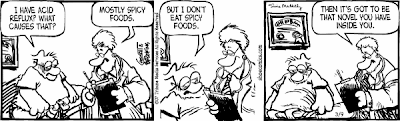
Cue the Snoopy dance. At 3:01 AM I finished the first draft of my novel. There is a beginning, a big juicy middle, and THE END. Except it's not. Now there's rewrites and re-rewrites and pitching, placing, and publishing the thing. The End is a mile marker, not a destination. But that doesn't take any of the joy out of it.

Anais Nin:
Life is a process of becoming.

Friday, March 09, 2007

The inevitability of fiction


I am within nanosyllables of completing my fifth novel, and looking through the manuscript today, fluffing and backfilling, I had occasion to return to some notes I made early on.

I stared at that file, thinking, Bgmdvpwha?

The book I envisioned and outlined so thoughtfully bears barely a fleeting resemblance to the book I wrote. But the book I wrote is the book that had to be written. It was the book I had in me. God knows, I would love to be more literary, more commercial, more Oprah-appropriate, more this, more that. But trying to write what I don’t have in me would be both futile and fatal.

Furry Muses


Sometimes, I don't know what I'd do without the furry muses I've had in my life. Over the years, they've kept me company, offered me diversions, and assured me that a wagging tale and a sloppy kiss are excellent antidotes for the poisonous bite of a rejection or a rough review.


The dogs I've adopted (nearly all from rescue groups) have taught me that steadfastness, in the long run, trumps the highwire excitement some people seem to crave. They've taught me that consistency and understanding can salvage a project others have discarded and turn it into something treasured. They've taught me the world is a subjective place, and that viewed through the lenses of love, the ugly can grow beautiful and the useless indispensible.


Is it any wonder that writers, who face so much rejection daily, have such soft hearts for animals? And especially for the underdogs, who symbolize our own struggles against heartrending odds.


I'm posting a photo of Zippy, a Humane Society "bounce-back" who had already been through at least two homes when we adopted her. She's turned out to be a terrific little mutt, a high-energy cuddler who makes us laugh every day.

I welcome you to share stories and pictures of your hairy muses in the comments section. I'd love to hear about them!

Tuesday, March 06, 2007

Birth of a Story

I was thumbing through my well-worn of Ray Bradbury's Zen in the Art of Writing the other day when I came across these lines:

"The stories, the plays, were born in a yelping litter. I had but to get out of their way."

Bradbury was talking about a series of tales set in Ireland, which he had sworn he had no interest in writing about. He found it a dank, depressing place during the time he spent there. But something tamped the seed down deep inside him, where it took root without his knowledge.

Stories happen like that sometimes, sneaking up when the would-be author least expects them. When they've had time to develop in the darkness, they do tend to come all at once, in a rush. When they're forced to light before their time, however, you end up with a painful forceps delivery, inch by bloody inch.

Monday, March 05, 2007

Saturday, March 03, 2007

The Amazing Shrinking Book Advance: "$125K is the new $250K" is the new BS

Industry blog Gawker shared this semi-discouraging word yesterday:
Book-buying editors sound like they're feeling the heat more than ever. What at least one big-house big-wig editor is telling the cute young novelists this week is that, in the current thinking on author advances, "$125K is the new $250K." We imagine what this really means is that he's damn sick of paying a quarter of a million bucks for a novel that has a 1 in 800 chance of earning out.


You know...yeah. It might mean that. Or it might mean that publishing is like any other industry in America. Top heavy. People at the top expect and receive huge money, while people at the bottom get squat, because that's what they expect and accept.

A lot of people want to write books, but only a few actually do it, and even fewer do it well. So why are those vanishing few not valued in our culture in general or our industry in specific? And why are so many authors willing to settle for sweat shop money?

Answer to both questions: Because we don't value ourselves.

We accept statements like "Nobody's paying more than $125K" (or "nobody's paying more than $5K") without challenge. After having our feet held to the fire by editors, we don't turn around and hold the publisher's feet to the fire, demanding an accurate and prompt accounting of how the book's PR budget was spent, exactly how many books sold through, and what the TRUE average advance is for the type of book we're writing.

The most common excuse for a crap advance is the poor performance of an author's previous title. Supposedly, you're only as good as your last book, and if a book tanks, you assume -- along with everybody else -- that it's your fault, when in fact, writing books is the job of writers and selling books is the job of publishers. Somewhere, someday, a midlist author will step up and say, "If it's possible to market a pet rock, for Christ sake, it's possible to market my book, and somebody in the marketing department should have by God done it."

And then a piglet will fly by outside the 32nd floor window.

So many people want to be published -- and they want it so badly -- we're willing to believe just about anything that begins with the words "We love your book." But for our own sake and the sake of our art, we need to start calling BS on any theory that tries to justify the shrinking value of our work.

Friday, March 02, 2007

Who, Me? Spiteful?

Today, I learned a terrific new word (to me): schadenfreude, which refers to the unsettling and unwholesome joy one feels when hearing of the misfortunes of another.

http://www.m-w.com/dictionary/schadenfreude

It is, unfortunately, a condition I can occasionally relate to, when misfortune befalls others who have gotten More Than Their Fair Share, in the eye of the jealous child-self that occasionally throws a nasty tantrum when others appear to be effortlessly grabbing the brass rings I'm unable to reach. My good-girl self knows better, and I always make an effort to act appropriately while burning with shame about my baser emotions.

But at the moment, it feels pretty good to know it's common enough to have a name.

It's also common enough to have an "anthem," in the form of a hilarious poem by Clive James called "The Book of My Enemy Has Been Remaindered," which I first read about in Anne Lamott's hilarious Bird by Bird.

If James' poem doesn't spark at least a smile of recognition, I'm not sure I want to know you. Here's the opening:

"The book of my enemy has been remaindered
And I am pleased
In vast quantities it has been remaindered.
Like a van-load of counterfeit that has been seized
And sits in piles in a police warehouse,
My enemy's much-prized effort sits in piles
In the kind of bookshop where remaindering occurs..."

So today, I'm thanking the creators of the word "schadenfreude" and Clive James for making me feeling human. After all, owning up to one's less admirable qualities is the first step toward mining them in fiction.

Thursday, March 01, 2007

Finding the good in losing the way

From Dante's Inferno translated by Henry Wadsworth Longfellow:
Midway upon the journey of our life
I found myself within a forest dark,
For the straightforward pathway had been lost.

Ah me! how hard a thing it is to say
What was this forest savage, rough, and stern,
Which in the very thought renews the fear.

So bitter is it, death is little more;
But of the good to treat, which there I found,
Speak will I of the other things I saw there.

I cannot well repeat how there I entered,
So full was I of slumber at the moment
In which I had abandoned the true way.